Concept preview. Not indexed. Facts are checked against the sources listed on each page.
Best time to see the Milky Way in Yellowstone National Park
June, July and August are the best months to see the Milky Way core at Yellowstone National Park. The best week of 2027 is July 1 to 7, when the core is above 10 degrees in full darkness with the moon below the horizon for about 3.0 hours a night.
Jun, Jul and Aug
Best months for the core
16°
Highest point of the core, due south
65%
Average cloud amount over the year
45
Top core score out of 100, in July
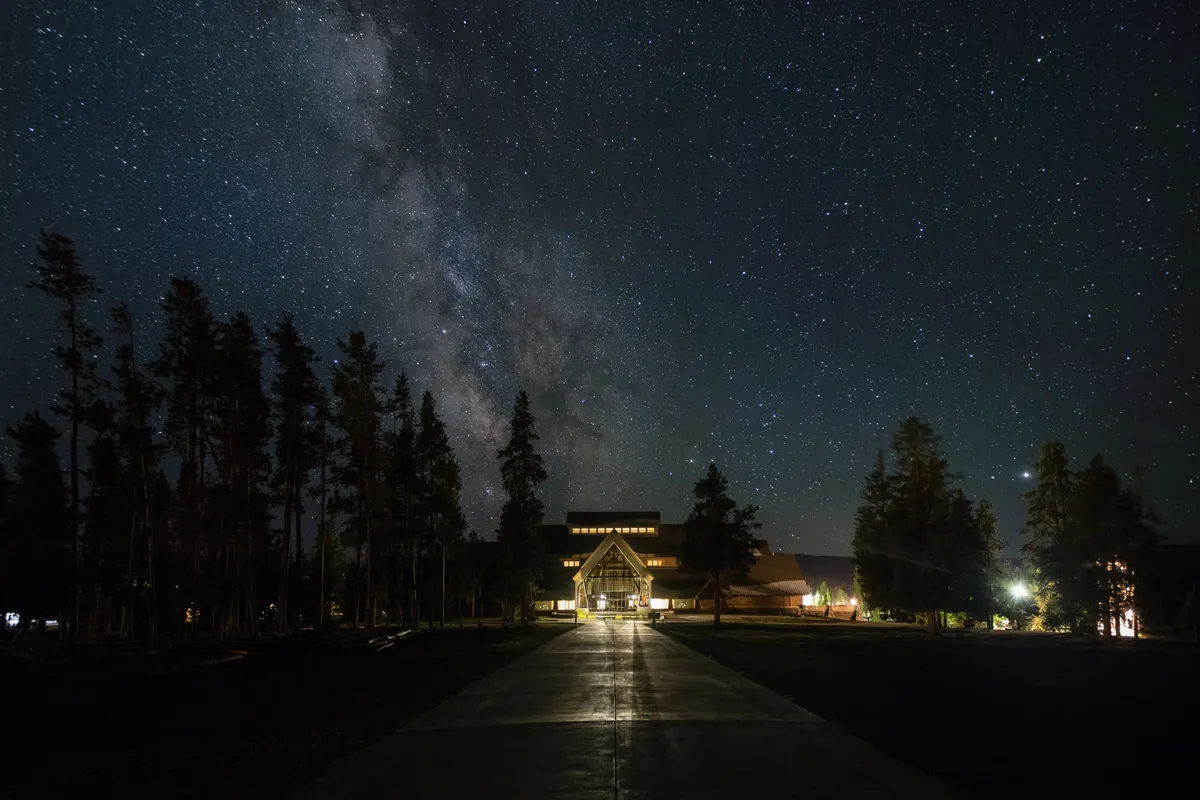
The core clears 10 degrees during full darkness on most nights from March to September. In January, February, October, November and December it is out of reach, either too close to the Sun or too low in the dark.
Core score by month
| Month | Core score | Best week | Moon-free core hours a night | Average cloud |
|---|---|---|---|---|
| January | 0 | Core not visible | 0 | 75% |
| February | 0 | No moon-free core hours | 0 | 77% |
| March | 3 | March 10 to 16 | 0.6 | 77% |
| April | 10 | April 7 to 13 | 1.4 | 73% |
| May | 15 | May 4 to 10 | 2.2 | 73% |
| June | 34 | June 1 to 7 | 3.3 | 58% |
| July | 45 | July 1 to 7 | 3.0 | 39% |
| August | 25 | August 1 to 7 | 1.8 | 43% |
| September | 8 | September 1 to 7 | 0.6 | 48% |
| October | 0 | October 1 to 7 | 0.0 | 64% |
| November | 0 | Core not visible | 0 | 73% |
| December | 0 | Core not visible | 0 | 77% |
Times are for the best seven nights in each month. Moon-free means the moon is below the horizon. The core counts as visible above 10 degrees in full darkness, when the Sun is more than 18 degrees below the horizon.
The best nights in 2027
- June: June 6 is the best night. The core is above 10 degrees and the moon is down from 11:52 pm to 3:12 am, with the moon 9% lit that night.
- July: July 1 is the best night. The core is above 10 degrees and the moon is down from 11:42 pm to 2:42 am, with the moon 5% lit that night.
- August: August 1 is the best night. The core is above 10 degrees and the moon is down from 10:52 pm to 12:42 am, with the moon 0% lit that night.
Clock times are Mountain time with daylight saving applied. The best nights fall around the new moon, so the dates shift by about 11 days each year.
About the park
Yellowstone National Park is a national park in Idaho, Montana and Wyoming. The National Park Service places its center at 44.60 degrees north and 110.55 degrees west, and the sky calculations on this page use that point. Visitor information, fees and alerts are on the park's own page. National Park Service.
How Yellowstone National Park compares
Its best monthly core score of 45 ranks 41 of 54 national park units that can see the core. The highest is Lassen Volcanic National Park at 86, and the lowest is Voyageurs National Park at 13. Cloud at Yellowstone National Park runs from 39% in July to 77% in February.
The score ranks months and parks. It is not a forecast for any night, and it leaves out local weather, smoke and light from nearby towns. How the core score works.
Nearest parks
Sources and method
- Sun, Moon and galactic centre positions calculated for the park's latitude and longitude from the low-precision formulas in Paul Schlyter's "Computing planetary positions", with the standard sidereal-time and horizon formulas. The code is checked against known events: new and full moons within 5 minutes, and the September equinox within 1 minute.
- Cloud: monthly mean cloud amount, 25-year Meteorological and Solar Monthly & Annual Climatologies (January 2001 - December 2025), from NASA POWER (version v2.10.1, source SYN1DEG), accessed October 19, 2026. Data obtained from NASA Langley Research Center POWER Project.
- Park facts: National Park Service.